
What Causes Damp Patches Near the Ceiling and Could the Roof Be to Blame?
Damp patches near the ceiling are one of those things people often notice and then quietly ignore, at least for a while.
It might start as a faint stain or a slight change in paint colour, nothing too alarming at first glance. Still, these marks rarely appear without a reason, and they tend to get worse if left alone.
In many cases, the roof is a likely place to look, particularly if the issue seems to develop after wet weather. That said, it is not always quite that straightforward.
There are a few different causes worth considering, and understanding what might be behind it can help you avoid unnecessary repairs or delays.
What Do Damp Patches Near the Ceiling Usually Look Like?
Damp patches can vary quite a bit in appearance, which sometimes makes them harder to identify straight away.
You might notice yellow or brown staining, darker patches that seem to spread, or even paint that begins to bubble or peel. In some cases, the plaster itself may feel slightly soft to the touch.
Another thing people often mention is that the patch changes over time. It might become more noticeable after heavy rain, then seem to fade slightly as things dry out.
If the mark is positioned close to the edge of the ceiling or directly beneath the roofline, it may suggest that water is entering from above rather than forming inside the room.
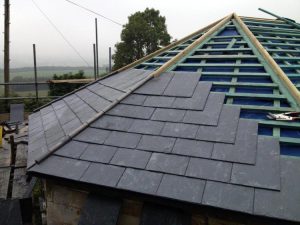
Common Roof-Related Causes of Damp Patches
Damaged or Missing Roof Tiles
Roof tiles do not need to be completely missing to cause problems. Even a small crack or a tile that has shifted slightly out of place can allow water to pass through over time.
Once water gets beneath the outer layer, it can travel along timbers or felt before eventually showing up as a damp patch indoors.
Because of this, the source of the problem is not always directly above the visible stain. Water has a habit of moving before it settles, which can make these issues a bit misleading.
What appears to be a minor cosmetic issue could actually trace back to a small but important fault higher up on the roof.
Faulty Flashing Around Chimneys or Roof Joints
Flashing is there to protect the more vulnerable areas of the roof, such as where the roof meets a chimney or wall.
Over time, it can wear down, loosen, or crack, particularly with constant exposure to changing weather conditions. When that happens, water can begin to seep in through those joints.
This type of issue may not be immediately obvious from the ground. It often develops gradually, with small amounts of water entering during rainfall.
Eventually, this builds up enough to become visible inside, usually as a damp patch near the ceiling or along a nearby wall.
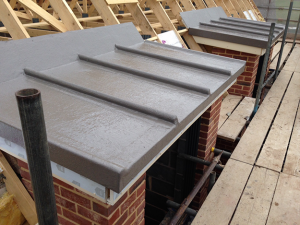
Issues With Flat Roofing Materials
Flat roofs tend to behave a little differently from pitched roofs. Water does not run off as quickly, which means any weaknesses in the surface can become a problem.
Small cracks, splits, or areas where water pools for longer than it should may allow moisture to work its way in.
What makes flat roof issues slightly tricky is that they can go unnoticed for quite some time.
The damage is often subtle at first, and by the time a damp patch appears indoors, the underlying problem may have been developing for a while.
Blocked or Overflowing Gutters
Gutters are easy to overlook, but they play a bigger role than many people realise. When they become blocked with leaves, moss, or debris, water can no longer flow away properly.
Instead, it may overflow or back up towards the roofline.
This excess water can sometimes find its way under the edge of the roof or into the fascia area.
From there, it may begin to affect the internal structure, eventually leading to damp patches appearing along the ceiling edges or corners of rooms.
Causes That May Not Be Related to the Roof
Condensation Build-Up
Not all damp patches are caused by external water getting in. In some homes, condensation can be the main issue, especially in rooms where there is a lot of moisture in the air.
Bathrooms and kitchens are common examples, particularly if ventilation is limited.
When warm, moist air meets a cooler ceiling surface, it can leave behind water droplets.
Over time, this repeated build-up may begin to look like a damp patch. It is easy to mistake this for a leak, even though the cause is coming from within the property.
Plumbing Leaks in the Loft
Another possibility is a plumbing issue in the loft space. Small leaks from pipes, tanks, or fittings can go unnoticed for quite a while, especially if they are slow.
The water may gradually soak into insulation and ceiling materials before becoming visible below.
Because these leaks are often hidden, they are sometimes overlooked during initial checks.
If the roof appears to be in good condition, it may be worth considering whether a pipe or fitting above the ceiling could be responsible instead.
Insulation and Ventilation Issues
Poor insulation or a lack of airflow in the loft can also contribute to damp conditions.
Without proper ventilation, moisture can become trapped, leading to a build-up over time. This may eventually show as damp patches or even light mould growth on ceilings.
In some cases, the issue is not a single fault but a combination of factors.
A slightly cold loft space, limited airflow, and everyday moisture from inside the home can all play a part in creating the conditions for damp to develop.
How to Identify Whether the Roof Is the Problem
One of the simplest ways to narrow things down is to pay attention to when the damp patch becomes more noticeable.
If it tends to worsen after rain or during particularly wet periods, the roof is likely to be involved in some way.
It can also help to take a look inside the loft, if it is safe to do so.
Signs such as damp insulation, water marks on timber, or even small amounts of daylight coming through can point towards an issue with the roof covering. If nothing obvious stands out, a professional inspection may be the next step.
Why Damp Patches Should Not Be Ignored
It might be tempting to treat a damp patch as a minor cosmetic problem, especially if it is small. However, these issues rarely stay the same.
Moisture can gradually weaken materials, leading to more noticeable damage over time.
There is also the risk of mould developing, which can affect both the property and indoor air quality.
What starts as a faint mark on the ceiling could eventually require more extensive repairs if the underlying cause is not addressed early.
When to Call a Professional
If the damp patch continues to spread, reappears after being cleaned or painted over, or is accompanied by other signs like dripping or a musty smell, it is usually a sign that the issue needs proper attention.
Guesswork can sometimes lead to treating the symptom rather than the cause.
A qualified roofing professional can assess the condition of the roof and identify whether it is the source of the problem.
Even if the issue turns out to be something else, having a clear answer can help you move forward with the right solution.
Conclusion
Damp patches near the ceiling can be caused by a range of issues, and while the roof is often a likely culprit, it is not always the only explanation.
Taking the time to understand what might be behind the problem can make a real difference.
In most cases, acting sooner rather than later tends to save both time and expense.
Whether the cause is a minor roofing fault, a blocked gutter, or something internal, identifying it early usually leads to a much simpler fix.